
Featured Archaeology Major: Ian Bayliss
"My interest in archaeology began after a series of Late Bronze Age and Egyptology classes through the archaeology and NES departments."
 Department Homepage
The College of Arts & Sciences
Department Homepage
The College of Arts & Sciences
"My interest in archaeology began after a series of Late Bronze Age and Egyptology classes through the archaeology and NES departments."


"Archaeology is increasingly interdisciplinary, and some of the most interesting work happens when you’re willing to borrow tools and ideas from outside your own field."


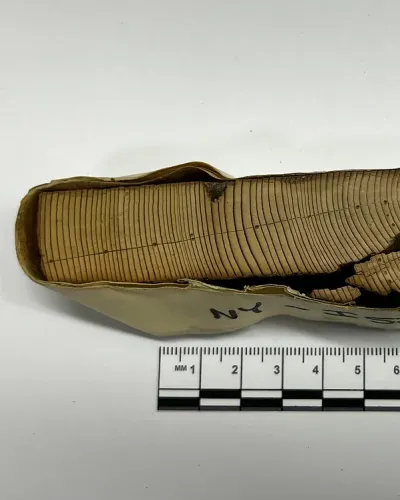
The Cornell Tree-Ring Laboratory identified the likeliest timeline of the Hellenistic-era ship's sinking as between 296-271 BCE, with a strong probability it occurred between 286-272 BCE.


Milan Taylor is an anthropology & archaeology major.

Afghan visual artist Elja Sharifi, currently a visiting scholar at the Herbert F. Johnson Museum of Art, sees her escape from the Taliban as a call to action. She will enter Cornell’s PhD program in art history next fall.

The collection “Households in Context: Dwelling in Ptolemaic and Roman Egypt” shifts the archaeological perspective from public and elite spaces such as temples, tombs and palaces to everyday dwellings and interactions of families.

As a new faculty fellow in the Milstein Program in Technology & Humanity, Adam T. Smith co-developed the new course this spring.

The grants provide funding for students in unpaid or low-paying summer experiences to offset the cost of taking on those positions.

“The conference showcased the true intergenerational and diverse group of scholars involved in Andean Studies,” said Prof. Cohen-Aponte.

Cornell employs 790 postdoctoral scholars who are appointed across nearly 90 departments where they actively participate in the university’s research, teaching, and extension missions.

Faculty researchers paint a picture of what will happen if multilateral organizations fail to protect Armenian cultural heritage as Azerbaijan shells the disputed region.

The funded community-engaged learning projects provide opportunities for students to excavate ancient Pompeii, establish a community garden in Moshi, Tanzania and more.

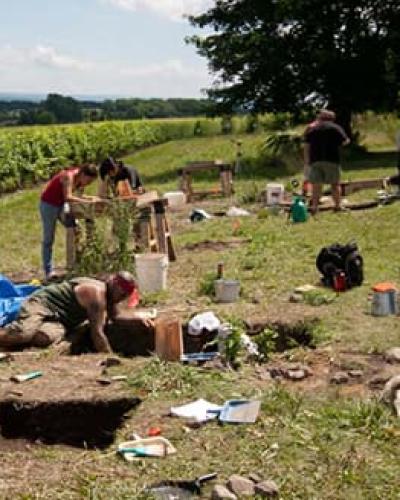
MyKayla Williamson's archaeological excavation takes place on Estate Little Princess, a plantation where people of African descent lived and worked starting in circa 1740.
Lisa Sasaki ’97 is helping to shepherd the high-profile new Washington, D.C., institution into existence
Faculty from six colleges across Cornell tackle issues ranging from the health of endangered wild dogs to the spread of misinformation through social media.
A&S faculty members will delve into questions ranging from quantum computing to foreign policy development and from heritage forensics to effects of climate change.
This summer, 101 students in the College of Arts and Sciences will take part in groundbreaking research on campus with 61 faculty as part of the Nexus Scholars Program.

Charlee Mandy is an archaeology and classics major.

Hannah Master is an archaeology and Near Eastern studies major.